

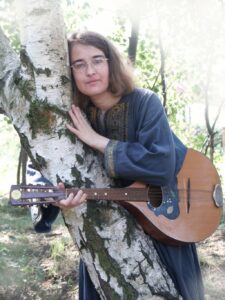
My musical roots lie in folk music—I love bands like Steeleye Span, the Albion Band, Fairport Convention, or the John Renbourn Group, and the early records by Pentangle before the group was taken over by Jacqui MacShee, but also modern British folk like that of the OysterBand. I’ve been playing guitar since I was thirteen, and I’ve actually been singing for as long as I can remember. I’ve also always wanted to have my own band. My parents played in a youth band called Heupferd when I was little—and I can only congratulate anyone who manages to track down one of their records—and in a band called Skunk Train when I was older—at our house, there was actually always some kind of music being made that stayed outside the mainstream.
From 1992 to 1993, I actually played in a folk group – it went by the grand name of the Folk Group of the Dülmen Music School and eventually fell apart because all the members had different ideas about what they actually wanted to do – classic British folk in the style of ‘Scarborough Fair’ or American folk in the Bob Dylan style… But at least – we had three gigs, one of which was so dreadful that things can only get better with Lord Landless.
Years later, by which time I was living in Cologne and training to be a bookseller, I learned about filk from Esteban (who is as famous as he is notorious in the German filk scene). He took me to the 1999 Filkcontinental, though our joint performances (in ’99 and ’00) turned into absolute disasters—after which I solemnly vowed never to perform with him again. Up until then, I had only ever written novels and poems, apart from a few very rare songs (mostly embedded in a story), but inspired by the filkers, I set about writing my own songs. The focus is still on the lyrics, but I now compose most of the melodies myself, and I’m proud that there are even a few catchy ones among them (Die Quelle).
I’ve known Silva since 1998—the singing fantasy author was a classmate of my boyfriend’s. In the fall of 2000, after I had given Esteban the musical boot—we joined forces as Lord Landless, performed a few songs at the Krefeld Tennis Club over Christmas, and have been a great singing team ever since, even though our professional and personal paths have always run separate. I would like to take this opportunity to thank—in addition to Silva, Esteban, and my boyfriend—my voice teachers, without whom I still wouldn’t know where my diaphragm is, let alone what it’s for.
And when Thesilee isn’t busy making music?
I reckon it’s quite possible that my mum was bitten by a book whilst she was pregnant with me – because that explains why my whole life seems to revolve around books. I’ve devoured books ever since I learnt to read – and then I worked part-time in the school library, then in the town library, and then I studied library science. Later, I trained as a bookseller. And in the end, I realised: I love computers.
I’d love to be able to programme properly, but unfortunately I didn’t quite manage that – just web design, at least. And I can set up Linux systems, and at my jobs I always end up being the one who looks after the network. With a twinkle in my eye, I crawl around under dusty desks assembling or dismantling computers, and I’m delighted when they’re up and running again and my desperate colleagues are happy once more. Unfortunately, though, that doesn’t help me with my actual job: I don’t sell a single book.
So now – at the start of 2008 – I’m unemployed and have already set about pursuing my next life’s dream: I’m going to be an author. A proper author. For money! I want to be able to make a living from writing books – Keep dreaming, child, or at least be hard-working… I’m trying to do both. After all, I’ve been writing for just as long as I’ve been reading. And I’ve been making up stories for ages, even if they weren’t really ready for the press. But I’ve worked my way up: first I left the children’s books behind, then the Brechtian poems, then the crime novels, and just as I was starting to call myself a fantasy author, I decided to throw all genre considerations overboard and just write incredibly good books.
Of course, it’s still predominantly fantasy, but I don’t like this pigeonholing. All stories—the genre is
irrelevant—are about people. And I want to write about people. It’s the same in my songs—I tell stories about people, and about what moves them: love, greed, stupidity, revenge. But whereas my songs are mostly meant to make you smile – at least in a wicked sort of way – my prose is more serious. Not because I want to be more profound, but because I have so many words inside me that want to come out, and if they can’t, they start playing ‘tag’ in my head.
And what else do I get up to when the day is long? I enjoy role-playing sessions, avoid sport, wander through cemeteries – and lately I’ve had a growing ambition when it comes to baking perfect cakes and tarts. Because even somewhere deep inside me, a little domestic, bourgeois soul lies dormant. But then again, I am the older one of the two of us.
Thesilee’s Instruments
Yamaha CG 150S (1989)
I started guitar lessons at the age of thirteen, mainly because my younger sister was going to have some and I naturally didn’t want to be left out. But our parents were cautious: they didn’t want to spend hundreds of Deutschmarks on a guitar if the child might say after just three months, ‘I’ve lost interest…’. So I was given my mother’s old guitar. Plywood, worn-out frets, it clattered and clanked, but what made my playing anything but a treat for the ears was my wretched technique. There is (unfortunately) a video recording of my first recital – Christmas 1988 – which documents everything in minute detail.
It shows where a lack of practice and a tense posture can lead. But I stuck with it. And on my fourteenth birthday, I went to Dortmund with my father to buy a guitar. There was just one problem: the child is left-handed! Of course, you can choose a guitar purely on appearance, but you want to have tried out the guitar for life (because that’s what it was meant to be, no more and no less) to know how it feels. My father described to the dealer what we were looking for: solid top, up to 600 DM. And I was spoilt for choice. I could play just one song by heart: ‘What Shall We Do with the Drunken Sailor’. And I tried it on every guitar, agonisingly slowly, because I had to mentally convert the string numbers at the same time. Even today, thirteen years later, I’m still unable to play a normal, right-handed guitar.
In the end, I opted for this gorgeous golden-yellow Japanese gem (yellow is my favourite colour). My father restrung it with the strings reversed, carved a new bridge, and ever since, the Yamaha has been my guitar, accompanying me through thick and thin. It’s been with me at camp, at various filk cons and in Berlin for the CD recordings, and its sound has improved with every passing year.
Last winter, I suddenly noticed a crack in the top – the wood has probably become too dry from the heating. A repair isn’t possible, at least not at an affordable price. The sound is still fine, but eventually the time will come when I’ll have to retire the Yamaha and buy myself a new guitar. Hopefully not soon. But at least I can now play more than just ‘What Shall We Do with the Drunken Sailor’.
Mandola (Walthari Mittenwald) (2000)
Okay, I’m quite good at playing the kazoo. The nose flute too. And I used to have a jaw harp, but it broke and, besides, it always poked my tongue in such a stupid way. But basically, I never felt the need to play any instrument other than the guitar. A lute, perhaps, but that’s practically the same thing. And many beautiful instruments (violins, for example) are only available for left-handers as custom-made items. Unaffordable. My father plays and collects instruments with steel strings, which I used to dread – just the thought of what they might do to your fingertips… Until I saw and heard Talis Kimberley at FilkContinental 2000. And Talis was playing a mandola. Or a bouzouki, or something like that, but I thought it was a mandola. And I said to the others: “I want one of those too, one day.”
After the con, I told my parents about it. Less about our gig (back then still with Esteban, and it hadn’t gone particularly well), but mainly about my new passion for mandolas.
“Do you want one?” my father asked.
“Yes, eventually,” I replied.
“Come with me then,” said my father, and from the cupboard in the stairwell he conjured up an instrument. Old, completely filthy, with rusty strings, but quite obviously a mandola. “You can have it,” said my father. “I bought it twenty-five years ago in Dortmund, but it’s not really my sort of instrument.”
So there I was with my mandola, and two packets of spare strings. Back home in Cologne, I first took the old strings off (wind, wind, wind) and carefully washed the instrument with soapy water. There are a few nasty scratches and scuffs on the body, but the inlays are still intact and beautiful. Then came the hard part: fitting the new strings (wind, wind, wind). And recognising the key differences from a guitar: eight steel strings (G G D D A A E E) and – a loose bridge. Which I had removed. And I no longer knew where it belonged. Without the bridge, the mandola can be tuned so that each string plays the correct fundamental note – but it must also be in tune at the third, fifth and eighth frets. After much trial and error, and full of gratitude for my new tuner (without which I’d have ended up in a mental institution long ago), all the strings finally sounded right, except for the first G string (to which I’ve even dedicated songs, it cost me so much sleep).
I’m not that fussy, and I don’t have perfect pitch either: at some point I’d had enough (and Volker has since adjusted the bridge properly, so that even the G string sounds almost right), so I bought a plectrum and taught myself to play the mandola, worked out the chords (almost all of which are much easier to finger than on the guitar, but then again, there are only four different strings) and realised just how much fun you can have with steel strings, even without cutting your fingertips.
Nowadays I can accompany most pieces on the mandola as well, and I enjoy doing so because it’s a very powerful and – when necessary – loud instrument. It will probably always remain my second instrument – but it won’t be going back into the cupboard any time soon.